
Review
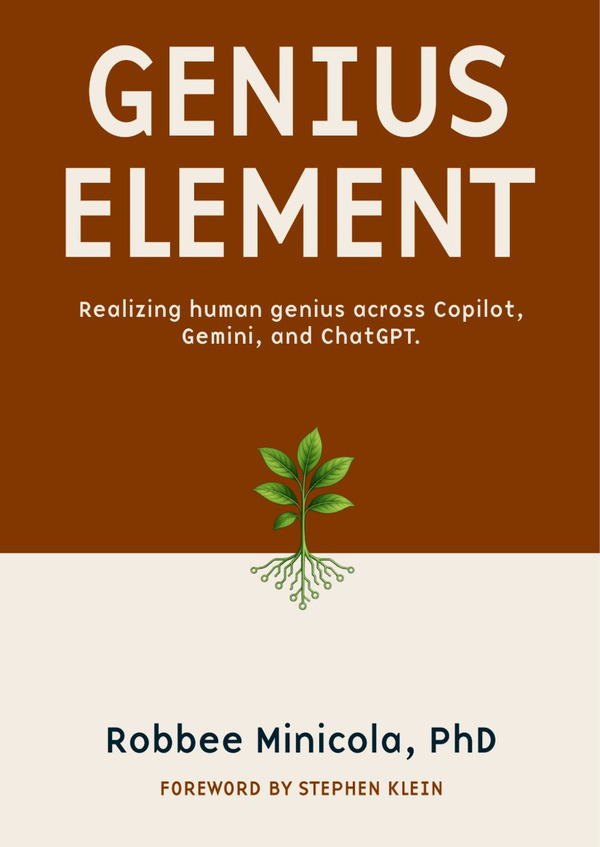
Genius Element
Realizing human genius across Copilot, Gemini, and ChatGPT
by Robbee Minicola
AI Reinvention Series, Book 2
SunDog Press. 08-05-2026. Paperback. 234 pp. ISBN 9798951267030. $18.99
In the second entry in the “AI Reinvention” series, a psychologist serves up an insightful, highly structured guide to shifting corporate AI adoption from mechanical task automation to profound cognitive transformation and original human judgment.
As corporate enterprises flood knowledge workers with generative AI tools, the narrative surrounding adoption has overwhelmingly focused on speed, efficiency, and task output. Psychologist and technology scholar Dr. Minicola delivers a timely and profound counter-narrative: generative AI’s true value lies not in automating work, but in transforming the mental landscape under which human judgment operates.
The core thesis of this second volume the “AI Reinvention” series hinges on a crucial distinction: AI surfaces signals, but humans assign significance. Rather than viewing generative AI as a competitor or replacement, Minicola frames intelligent systems as mirrors that externalize information, reduce mechanical cognitive load, and expose hidden institutional patterns. This frees human minds to engage in higher-order interpretation, ethical evaluation, and creative synthesis.
Structurally, it is a masterclass in pedagogical design. Across eight main chapters, Minicola addresses the fundamental psychological shifts required of workers. Each chapter opens with a vivid, fictionalized workplace narrative rooted in real organizational dynamics: Gloria Morales discovers that Copilot’s summary of project delays points not to a communication failure, but to a need for a “shared tempo” across siloed teams. Malcolm Hughes, a veteran spreadsheet analyst, realizes his thirty years of value reside not in generating vendor reports, but in interpreting structural supply-chain relationships. Priya Sundar learns to overcome self-censorship by using AI as an emotionally neutral sandbox for incomplete creative concepts. Naomi Patel navigates the ethical boundaries of predictive analytics when asked to generate individual attrition risk scores, illustrating that increased technological capability demands heightened moral responsibility.
Following each narrative, Minicola grounds the reader in established psychological literature, seamlessly weaving together Bandura’s self-efficacy, Csikszentmihalyi’s flow state, Edmondson’s psychological safety, Kahneman’s System 1 and System 2 thinking, and Kohlberg and Gilligan’s moral reasoning theories. Each chapter concludes with hands-on self-assessments and “Ignite Your Genius” prompts, ensuring that conceptual insight transitions immediately into reflective practice.
The back matter further elevates the book’s commercial utility. In an extensive section titled “Genius Prompts by Category,” Minicola provides business leaders with side-by-side prompt transformations, demonstrating how to shift queries from task execution (“Summarize this data”) to cognitive inquiry (“What patterns in this data would change how we interpret the problem?”).
Written with deep empathy, intellectual rigor, and practical lucidity, Genius Element avoids both breathless tech-optimism and alarmist fear-mongering. It stands out as an essential text for any professional seeking to preserve human agency, original thought, and principled judgment in an automated world. A stellar, highly recommended addition to business and organizational psychology collections. An Open Shelf starred review.
Reader & Market Readiness Ratings
- Reader Appeal★★★★☆
- Shelf Readiness★★★★☆
- Professional Polish★★★★★
- Audience Fit★★★★☆
- Library/Classroom Use★★★★☆
- Discovery Potential★★★★☆
- Review-ready Language★★★★★
- Book-club Potential★★★☆☆
- Series Potential★★★★★
Book Details
- Author
- Robbee Minicola
- Format
- Paperback
- Pages
- 234
- Publisher
- SunDog Press
- List price
- $18.99
- ISBN
- 9798951267030
- Category
- Nonfiction
- KeywordsAuthor-provided
- Nonfiction – Artificial Intelligence, Nonfiction – Technology, Nonfiction – Psychology, Nonfiction – Business & Careers, Nonfiction – Personal Development
- Publication date
- 08-05-2026
- Language
- English
- Series
- AI Reinvention Series #2