
Review
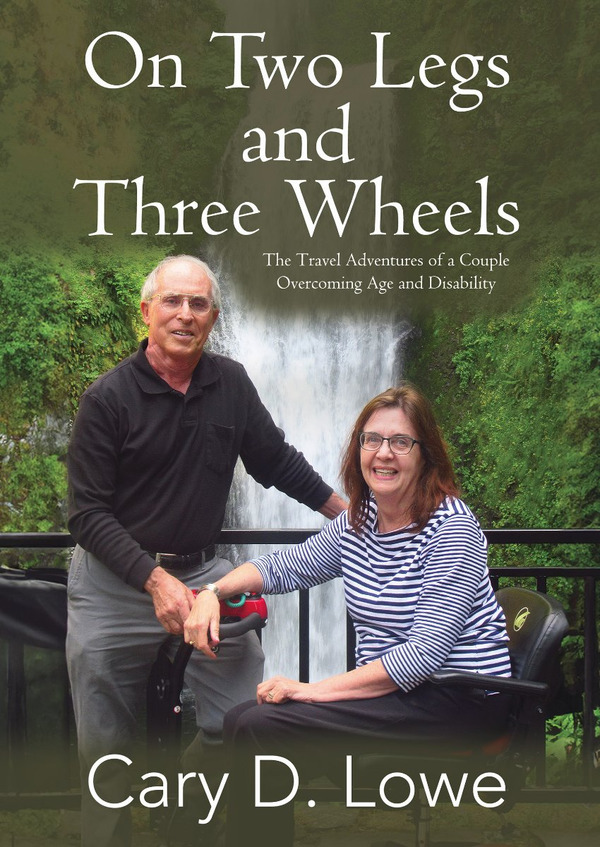
On Two Legs and Three Wheels
The Travel Adventures of a Couple Overcoming Age and Disability
by Cary Lowe
Black Rose Writing. 02-13-2025. Paperback. 332 pp. ISBN 9781685135584. $18.95
A love story and travel memoir that celebrates adventures while revealing the accessibility barriers travelers with mobility disabilities often encounter.
Lowe shares a love story shaped by commitment, teamwork, determination, and adventure. The memoir begins with a discussion of the evolving effects of multiple sclerosis on his wife Patricia (Trish) Butler. Together they navigate mobility barriers while pursuing their shared passion for exploration of “far-flung places.” Their travels span road trips, cruises, European cities, and outdoor adventures. Vivid descriptions of unique cultural landmarks bring each location to life for readers. In addition, photographs threaded throughout the memoir featuring the couple add meaningful personal dimension.
Lowe’s insights highlight the rewards of travel and the obstacles for people with mobility disabilities to fully participate. One of the book’s many potent arguments is its candid portrayal of accessibility challenges, including narrow multi-level buildings, uneven streets, and transportation systems. In-depth discussion of travel experiences with the unique issue of equipment failure adds authenticity that is often overlooked in the category of travel writing. The discussion also adds poignancy, without pathos, when Lowe demonstrates resourcefulness by bringing Butler a scoop of Arctic Ocean water because her scooter cannot reach the shoreline. These stories and the range of travel destinations truly broaden the memoir’s appeal.
However, the most significant limitation is the result of the predominantly husband-centered perspective. The author is clearly supportive of his wife, yet Butler’s own interpretation of her experiences is comparatively scarce. Her direct quotes enrich the account of their journey to the Arctic Ocean, and following a trip to New Orleans her candid frustration offers a valuable perspective that is missing in parts of the book: “I loved it all, but sometimes it felt really frustrating getting around. They may call New Orleans the Big Easy, but it wasn’t always so easy for me.” Additionally, the language frames disability as an obstacle or limitation to conquer, which makes the epilogue’s message both encouraging and dismissive: “They simply need to believe that they can continue to enjoy traveling and its associated experiences despite their age or physical limitations.”
Despite this, the book’s candid discussion of accessibility barriers remains critical. The couple’s experiences highlight the importance and impact of logistical planning and opportunities available to individuals with mobility disabilities; it will bring a mindfulness about the ease of travel to anyone embarking on such journeys.
Reader & Market Readiness Ratings
- Reader Appeal★★★★☆
- Shelf Readiness★★★★☆
- Professional Polish★★★★★
- Audience Fit★★★★☆
- Library/Classroom Use★★★☆☆
- Discovery Potential★★★★☆
- Review-ready Language★★★★☆
Book Details
- Author
- Cary Lowe
- Format
- Paperback
- Pages
- 332
- Publisher
- Black Rose Writing
- List price
- $18.95
- ISBN
- 9781685135584
- Category
- Nonfiction
- KeywordsAuthor-provided
- travel, inspiring, disabled, adventure, senior
- Publication date
- 02-13-2025
- Language
- English
- Genres
- Literary/General Family Life, Romance Contemporary