
Review
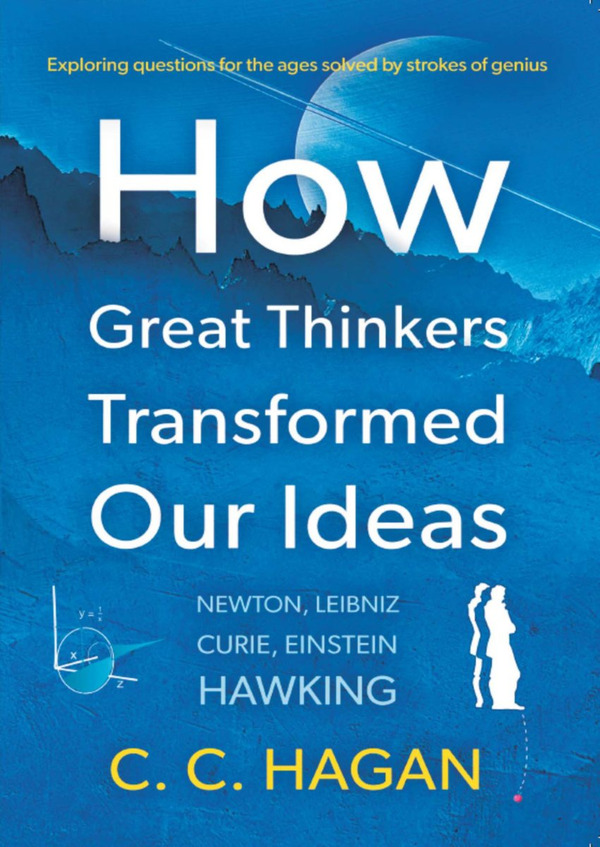
How Great Thinkers transformed our Ideas
by Christopher Charles Hagan
$25.00
A spinning, ambitious examination of the knowledge, philosophy, and lives behind a few of the Western world’s most brilliant minds.
When Stephen Hawking died in 2018, news outlets circulated a clip from Star Trek: The Next Generation in which Hawking, playing himself, sits down to a poker game with holographic versions of Albert Einstein and Isaac Newton. Hagan mentions the scene in the preface, and it seems to have sparked the book. He pulls at those common threads between five of the Western world’s greatest scientists, from the 17th century to the late Hawking. The book refers to them as the “true founders” of the Scientific Revolution. Newton, Gottfried Leibniz, Marie Curie, Einstein, and Hawking all play a part in the story of how science rewrote the world. Although they worked in vastly different branches of science, each built on and expanded the work of those who came before.
The lives of these scientists unfold in sets of dedicated chapters that illuminate their discoveries and the extent of their contributions to the scientific community. Hagan shows how these figures were shaped by the world around them and how they still shape ours, as in an anecdote connecting Leibniz to The Matrix. The author argues that understanding these scientists requires drawing on history, theology, and philosophy as much as science.
Later chapters contain terminology that may vex some readers. Are you familiar with the cosmological constant? How about Zeno’s paradox? If not, you may find yourself wishing Hagan had included a glossary. This isn’t an introduction; it’s best suited to readers who have worked through books such as A Brief History of Time and want to go further.
There is a bit of self-awareness involved here; Hagan provides notes and brief summaries of the more difficult concepts and invites readers to skip ahead if they wish. The author works to make the book as accessible as possible. Most readers will infer and identify the key elements of the discussion even if they have not fully grasped every idea. Some terms demand more background than the average reader has, but Hagan’s command of the subject keeps the book enthralling. The book is very much worth a purchase for those with a more developed philosophical or scientific grounding.
Reader & Market Readiness Ratings
- Reader Appeal★★★★☆
- Shelf Readiness★★★★☆
- Professional Polish★★★☆☆
- Audience Fit★★★★★
- Library/Classroom Use★★★☆☆
- Discovery Potential★★★★☆
- Review-ready Language★★★★★
Book Details
- Author
- Christopher Charles Hagan
- List price
- $25.00
- Language
- English