
Review
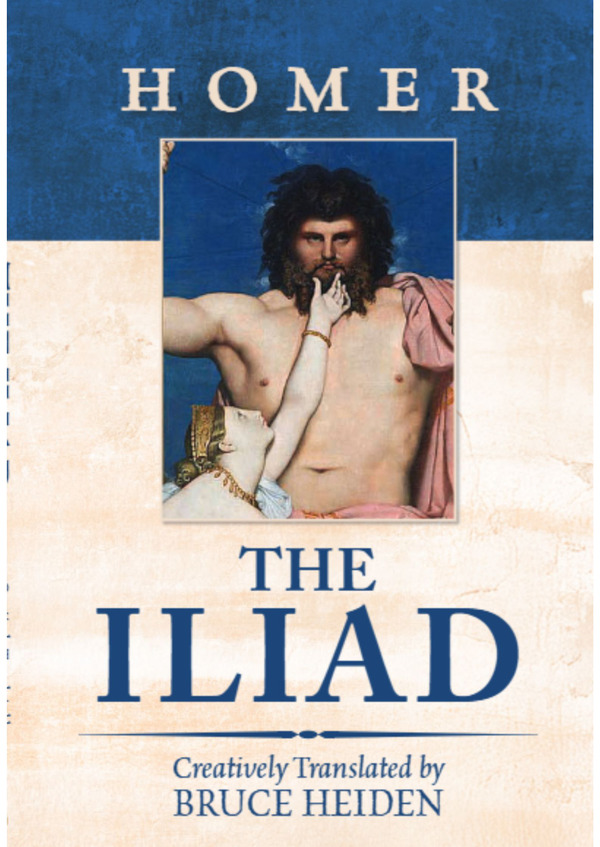
The Iliad
Creatively Translated
by Homer
Translated by Bruce Heiden
2025. Paper. 582 pp. ISBN 9798822984714. $21.99
A brilliant Homeric scholar restores the wit, fury, and humanity of an ancient epic in a translation meant to be heard.
There is no shortage of English translations of Homer’s Iliad, but Heiden (Tragic Rhetoric: An Interpretation of Sophocles’ Trachiniae and Homer’s Cosmic Fabrication: Choice and Design in the Iliad) makes a persuasive case for another. A distinguished Homeric scholar, Heiden approaches the ancient epic with formidable learning and an evident delight in language. His achievement is not simply to make Homer accessible, but to make the poem feel alive in the mouth and mind of a contemporary reader.
The opening retains the gravity of epic tradition: “The rage, O Goddess, recite, the righteous rage.” Yet Heiden soon introduces a startlingly conversational vocabulary. Achilles calls Agamemnon a “fat cat king”; elsewhere, ancient warriors sound remarkably like men arguing over power, money, and wounded pride. The effect recalls Shakespeare’s effortless passage between elevated poetry and earthy human exchange. Heiden’s characters are not modernized into caricatures. Rather, their vanities, grievances, humor, and contradictions become immediately recognizable.
This is a translation particularly rewarding when read aloud. Heiden’s word order, repetitions, shifting registers, and carefully placed interruptions invite performance (a podcast?). The language carries the reader forward, making room for both the pleasures of poetry and the immediate comprehension of events. One need not continually decode archaic English to appreciate the sophistication of the original drama.
Heiden also provides interpretive book titles, from “Hera’s Sexy Scheme” to “Funeral of Fame,” and divides the epic into three movements. These are not scholarly concessions to an inattentive audience but invitations to appreciate the poem’s theatrical architecture. His inventiveness occasionally risks drawing attention to the translator rather than the poet, particularly when contemporary idioms become conspicuous. Yet his command of contrasting voices is central to the enterprise.
Perhaps most telling is the closing movement, when Hector’s death is mourned not in grand pronouncements of military glory but through the intimate recollections of those who loved him. Helen remembers his kindness; his family confronts an absence no heroic reputation can repair. Heiden allows these moments to reverberate, without explanatory intrusion.
Readers devoted to more ceremonious translations may find his colloquialisms surprising. Others will discover that familiarity need not diminish grandeur. Heiden understands that an epic survives not through reverence alone but through renewed engagement. This is a translation that welcomes readers into the intellectual and emotional pleasures of Homer—and leaves them feeling enlarged by the encounter. An Open Shelf starred review.
Reader & Market Readiness Ratings
- Reader Appeal★★★★★
- Shelf Readiness★★★★★
- Professional Polish★★★★★
- Audience Fit★★★★★
- Library/Classroom Use★★★★★
- Discovery Potential★★★★★
- Review-ready Language★★★★★
- Book-club Potential★★★★★
- Read-Aloud Appeal★★★★★
Book Details
- Author
- Homer
- Translator
- Bruce Heiden
- Format
- Paper
- Pages
- 582
- List price
- $21.99
- ISBN
- 9798822984714
- Category
- Fiction
- Publication date
- 2025
- Language
- English