
Review
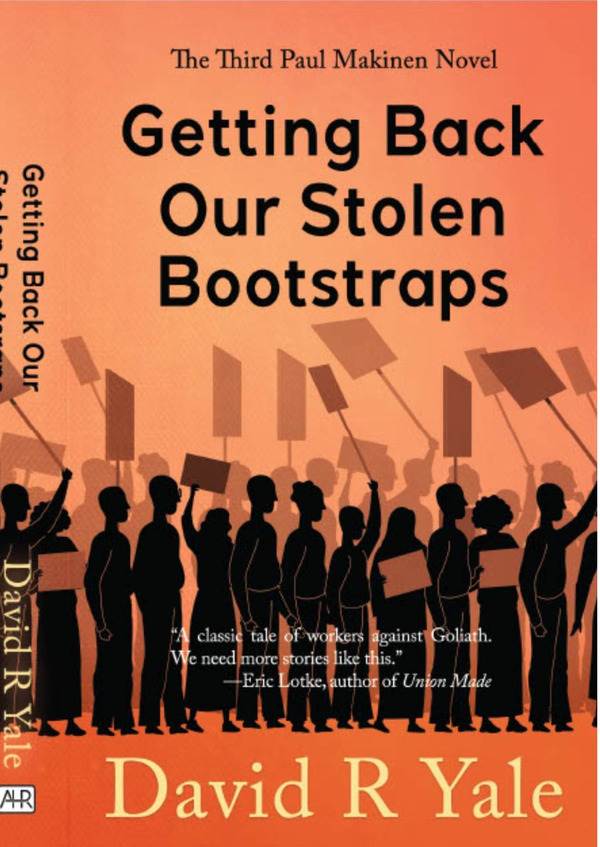
Getting Back Our Stolen Bootstraps
The Third Paul Mäkinen Novel
by David R Yale
Shingle Creek Sagas, Book 4
Healthy Relationship Press. 05-15-2024. Paperback. 410 pp. ISBN 9798986300658. $17.99
An earnest labor novel in which meticulous historical research and moral urgency unfold through explanatory dialogue, community organizing, and meeting-room sprawl.
In 1972 Minneapolis, 19-year-old Paul Mäkinen is director of Shingle Creek Park and helps lead the community of working-class “Creekers” against a corrupt alliance of business owners, politicians, police, and media. After a Parks superintendent, a trusted friend and ally, is killed by police, Paul’s community responds with lawsuits, strikes, an underground newspaper, and an industrial safety commission. Woven through this civic saga is Paul’s personal journey as he works through childhood trauma, in positively portrayed therapy, and struggles with his romantic relationship with 16-year-old assistant director Karen “Rennie” Ahlberg.
The novel’s strength lies in powerfully depicting labor history and civic process embedded in the stories of everyday people and supported by nonfiction resources. Courtroom scenes play out with palpable procedural tension, while a militia attack on a peaceful protest, resulting in the racially targeted killing of a child, lands with uncomfortably familiar weight. Concrete images cut through the policy-heavy narrative: a wedding band forged from steel associated with a worker’s industrial death, captured rifles melted into a memorial sculpture, and recurring chokecherry bushes connecting childhood memory and grief.
The narrative exposition relies heavily on dialogue, often at the expense of momentum. Characters somewhat didactically explain labor law, finance, organizing strategy, or therapy to one another, at length. Repeated community meetings and exact vote tallies turn much of the back half into policy minutes rather than narrative, while jokey villain names and slapstick confrontations sit uncomfortably close to rape, child abuse, racist violence, and murder. An opening recap helps; however, there are more than 150 named characters. While the novel deliberately portrays Paul and Karen’s increasingly sexual relationship as mutual and respectful, contrasting it with depictions of coercion and sexual assault, it never meaningfully addresses Karen’s status as a minor or their workplace hierarchy. Content note: Sexual violence involving minors, suicide, child abuse, racially targeted violence, and mass-shooting deaths, including that of a child.
The novel demands considerable patience from its readers, but the well-researched blend of labor history, civics in action, and progressive politics will resonate with the specific audience for whom Yale writes.
Reader & Market Readiness Ratings
- Reader Appeal★★★★☆
- Shelf Readiness★★★★☆
- Audience Fit★★★★☆
- Library/Classroom Use★★★☆☆
- Discovery Potential★★★☆☆
- Review-ready Language★★★★☆
Book Details
- Author
- David R Yale
- Format
- Paperback
- Pages
- 410
- Publisher
- Healthy Relationship Press
- List price
- $17.99
- ISBN
- 9798986300658
- Category
- Fiction
- KeywordsAuthor-provided
- Unions, Strikes, Protests, Resistance, Democracy
- Publication date
- 05-15-2024
- Language
- English
- Series
- Shingle Creek Sagas #4
- Genres
- Literary/General Cultural Heritage